Autor: mymobilex
Coming to the US? Here’s how to get connected before you land.
You’ve booked your flights, sorted your accommodation, and packed your bags. The last thing you want when you land in the US is to queue at an airport kiosk for a SIM card, pay a premium for a week of data, and then deal with cancelling it when you leave.
There’s a better way. And you can set it all up before your plane takes off with some of the best cell phone plans ideal for travelers.
Why most visitor phone options fall short
The traditional options for international visitors aren’t great. Roaming on your home carrier is convenient but expensive; data charges can run $10 or more per day. Airport SIM kiosks are overpriced and often require a physical SIM that may not fit your phone. And walking into a carrier store when you arrive means paperwork, ID checks, and time you’d rather spend elsewhere.
What most visitors don’t know is that prepaid mobile plans activated entirely through an app – before you even board – is now a real option. No store, no plastic SIM, no contract. MobileX offers some of the best phone plans for those who want to skip the store, the plastic SIM, and the commitments.
What eSIM means for international visitors
An eSIM is a digital SIM card built directly into your phone. Instead of swapping out physical SIMs, you download your new US phone plans directly to your device. It takes a few minutes and works on most modern smartphones including iPhone XS and later, and recent Android flagships.
For an international visitor, this changes everything. You can research cell phone plans, activate service, and be fully connected the moment your flight lands, all from your couch at home before you leave.
How MobileX works for visitors
MobileX runs on one of America’s most reliable 5G networks, covering the cities and destinations most visitors are headed to. Here’s what makes it different from other options:
- No contract, no commitment — build customized cellular phone plans with exactly the data, talk, and text you need for your trip. A week in New York is a different data need than a month traveling across multiple states.
- Pay only for what you use — unlike roaming charges that rack up invisibly, you know exactly what you’re paying for before you start. These are some of the most affordable mobile plans on the market, with customized service starting at just $3.88/month.
- Activate before you land — download the MobileX app at home before your trip. The app is available on the Apple App Store and Google Play Store in the UK, Europe, Mexico, Australia and more. While connected to your home WiFi, activate a new line via eSIM, enter a US address when prompted, and you’re done. Pay with Apple Pay, Google Pay, or any credit or debit card. By the time you clear customs, you’re already connected.
- No store visit, ever — everything happens in the app. No queuing at an airport kiosk, no hunting for a carrier store, no waiting for a physical SIM in the mail.
And when you leave, don’t cancel your number
Here’s something most visitors don’t think about until it’s too late. If you’ve been using a US number during your trip and want to keep it for your next visit, or if you’re planning to come back, cancelling your plan means losing that number entirely.
For just $1.98 a month, you can keep your US number active between visits. No data, no talk, no text, just your number preserved and ready for when you return. It costs less than a coffee and saves you the hassle of setting up a new number every time you visit.
For anyone who travels to the US regularly for work or visits family, it’s one of the best wireless phone plans decisions you can make.
What you need to get started
- A compatible unlocked smartphone with eSIM support
- The MobileX app, available on the App Store and Google Play
- Apple Pay, Google Pay or credit or debit card for easy, hassle-free payment
- Your trip details, so you can build a plan around how long you’re staying and how much data you’ll realistically need
Frequently Asked Questions
Do I need a US credit card to sign up? No. MobileX accepts Apple Pay, making it easy to sign up for our prepaid phone plans from anywhere in the world before you arrive.
What network does MobileX use? MobileX runs on one of America’s most reliable 5G networks, with coverage across the country.
Can I keep my number after my trip? Yes. For just $1.98 a month, you can keep your US number active between visits without paying for a full phone plan. Add data whenever you’re ready.
What if my phone doesn’t support eSIM? You can request a physical SIM instead. However most modern smartphones released in the last three to four years support eSIM; you can check compatibility in the MobileX app.
Is there a contract or commitment? None. MobileX offers no-contract phone plans so you’re in control of your service from day one.
What if I need more data during my trip? You can always add additional data for $1.98/GB for standard access or $2.10/GB for priority access.
Heading to the US? Download the MobileX app, build the best cellular plans in minutes, and arrive already connected. No queues, no surprises, no fine print.
The free phone trap: what carriers don’t tell you.
Free phone. Two words that have sold more cellular phone plans than any other promise in wireless history.
You’ve seen the ads. Walk in with your old device, walk out with the latest flagship smartphone at no cost. It sounds like a no-brainer. But here’s what the fine print doesn’t say upfront: there is no such thing as a free phone. There’s just a phone you pay for in ways that are harder to see.
Here’s how it actually works.
The 36-month math
When a carrier offers you a “free” phone, what they’re really offering is a monthly device credit spread across 36 months — three full years. Instead of giving you the phone outright, they apply a portion of the device’s value to your bill each month, as long as you stay on a qualifying plan.
That qualifying plan is almost always their most expensive tier. So the “free” phones come with mandatory unlimited phone plans you may not need, at a price point that’s significantly higher than what you’d otherwise pay.
Run the numbers over 36 months and the phone is rarely free. It’s just paid for differently, in a way that’s harder to track and easier to forget.
What happens if you leave early
This is where it gets expensive. If you decide to switch carriers before your 36 months are up — because you found a better phone plan, because your service isn’t what you expected, because anything changed in three years, you lose the remaining device credits.
That means you’re on the hook for the full remaining balance of the phone. A flagship smartphone that was supposed to be “free” can suddenly cost you $400, $500, $600 or more the moment you decide to leave.
It’s one of the most effective retention tools in the industry. Not because the service is good enough to keep you, but because leaving costs too much.
The trade-in trap
Many free phone offers also require a trade-in. Your old device gets valued — usually below market rate — and that trade-in value becomes part of the credit calculation. So you hand over a phone that might be worth $300 on the open market, get credited $200 toward a new device, and lock yourself into a 36-month agreement in the process.
If you’d sold that phone yourself and put the money toward an unlocked device on a cheaper phone plan, you’d likely come out ahead. But that requires doing math that carriers are not motivated to help you do.
The plan requirement
Here’s the part that often gets missed entirely. Most free phone promotions require you to stay on a specific, higher-tier prepaid or postpaid plan for the full 36 months. Drop down to less expensive phone plans and you lose the credits. Switch plans and you may forfeit the remaining device value entirely.
You’re not just locked into a carrier. You’re locked into a price point. And that price point is almost always higher than what you’d pay if you’d bought the phone outright and chosen your cell plan independently.
The smarter way to think about it
Separating your device from your phone plan is one of the most underrated moves in wireless. When they’re bundled together, it’s nearly impossible to evaluate whether you’re getting a good deal on either one. When they’re separate, you can make a clear-eyed decision about each.
Buy the device you want, at the price that makes sense. Then choose one of the best cell phone plans for your actual usage. If your needs change, you can adjust your plan without losing anything. If you want to switch carriers, you can do that too — no penalties, no forfeited credits, no math to untangle.
It’s a simpler way to manage your wireless life. And in the long run, for most people, it’s a less expensive one.
Frequently Asked Questions
Is a free phone ever actually free? Rarely. Most free phone offers are device credits spread across 36 months or even longer, tied to a qualifying plan. Leave early and you forfeit the remaining credits and owe the balance on the device.
What should I look for before accepting a free phone offer? Check the required plan tier and its monthly cost, the length of the commitment, what happens to your credits if you switch plans or carriers, and what your trade-in device is actually worth on the open market before handing it over.
What does it mean to separate my device from my plan? It means buying your phone outright or through a third party, then choosing cellular plans independently. You’re not locked into any carrier or price point, and you can adjust either one at any time without penalty.
What kind of phones work with MobileX? MobileX is compatible with most unlocked smartphones. You can check device compatibility directly in the MobileX app.
Ready to take back control? Build the phone plan that fits your actual life on our website, or pick up a MobileX Activation Kit on Amazon or at one of 3,700 Walmart locations.
Top 9 Best Cell Phone Plans for 2026.
Dark mode is here. Your eyes will thank you.
At MobileX, we’ve always been about giving you total control over your mobile experience. That means more than just choosing the best cell phone plans. It means choosing how the app looks and feels while you use it. Today, we’re excited to announce that Dark Mode is now live in the MobileX iOS and Android apps.
Dark Mode is something our users have been asking for, and we’re glad to finally deliver it. It looks better, feels more modern and fits our brand. But beyond the looks, checking your data usage, adjusting your prepaid mobile plans or topping up your account is now much easier on the eyes in low-light settings. If you’re the kind of person who checks their phone usage from bed at 11 p.m., no judgment. We do it too. This update is for you.
How to Enable Dark Mode on the MobileX App
Switching to Dark Mode is simple. Once you’re in the MobileX app:
- Tap the menu icon on the top left
- Head to App Settings
- Select App Themes
From there, you can toggle between Light and Dark mode whenever you want. The app follows your device’s system theme by default, so if you already use Dark Mode, the MobileX app will match it automatically. To lock in Dark Mode regardless of your system settings, manually select the Dark theme.
At MobileX, we believe cellular phone plans should do more than just connect you; they should empower you to be who you are. If you want a traditional plan, we have the best prepaid wireless plans with unlimited options. If you want something tailored, our AI builds personalized cellular plans designed to lower your monthly bill. And if you want to manage it all in Dark Mode? Now you can.
Frequently Asked Questions
What version of the MobileX app do I need for Dark Mode? Dark Mode is available on MobileX app version 8.0.0 and above. Update your app via the Apple / Google Play app stores to access it.
Does Dark Mode work on both iPhone and Android? Yes. Dark Mode is supported on both iOS and Android versions of the MobileX app.
Will Dark Mode turn on automatically? By default, the app mirrors your phone’s system theme. You can override this at any time in App Settings > App Themes.
Update your MobileX app to the latest version today and flip the switch.
The fees hiding in your phone bill every month.
You signed up for a $60 phone plan. Your bill is $75. You’ve checked it three times and still can’t figure out where the extra $15 is going.
You’re not imagining it. And you’re not alone.
The gap between what carriers advertise and what you actually pay is one of the most consistent frustrations in wireless. Here’s exactly what those extra charges are, why they exist, and how to stop paying them by finding the best cell phone plans for your budget.
The fees that sound official but aren’t
Scan your phone bill and you’ll likely see charges with names like “Regulatory Recovery Fee” or “Administrative and Telco Recovery Charge.” They sound like government taxes. They are not.
These are fees carriers invented themselves. They can raise them whenever they want, with no government oversight and no cap. One major carrier recently raised its recovery fee to nearly $4.50 per voice line per month, and its own website confirms this is not a government tax. It’s a fee the carrier collects and keeps.
The administrative fee is even more vague. Carriers describe it as covering “general costs of operations,” an umbrella term that can mean almost anything. These fees have quietly increased across the industry in recent years, often with little notice and no explanation. Most people never catch it because it’s buried in the fine print.
This isn’t just frustrating. It’s been taken to court. Multiple class action lawsuits have been filed against the biggest names in wireless over fees customers say were deliberately disguised as government charges. One settlement alone cost $100 million. The fees are still there.
The activation fee
Switching to new cell phone plans or adding a line? Prepare for an activation fee on top of everything else. These one-time charges can run anywhere from $10 to $45 per line. Carriers justify it as the cost of setting up your service, even though the process is largely automated today.
It’s a charge for something that costs the carrier almost nothing to do. And it’s one of the first things you’ll notice is missing when you switch to prepaid phone plans that don’t believe in padding the bill.
The promo cliff
Many carriers hook you with introductory rates that don’t tell the whole story. You sign up for less expensive phone plans at $25 a month, only to find out in month four that the price has doubled. It’s designed to bank on your inertia. They’re betting you won’t notice, or won’t want the hassle of switching again.
And to even qualify for that advertised price on many cellular plans, carriers often require you to link your checking account or debit card to get the discount. It’s framed as a convenience. It’s actually a way to avoid credit card processing fees while keeping tighter control over your payments.
What a truly transparent phone bill looks like
At MobileX, we think you should know exactly what you’re paying for before you pay it. No recovery fees, no administrative charges, no activation fees. Just one platform fee of $1.98 a month, and the cost of your plan.
That’s it. One line item you can actually explain.
Our customized plans start at $3.88/month. One platform fee of $1.98 a month, plus applicable taxes – and that’s it. No recovery fees, no administrative charges, no activation fees, no promo rates that quietly double. Just one of the most affordable mobile plans on the market, priced exactly as advertised.
How to audit your current bill
Before your next billing cycle, take five minutes and do this:
- Pull up your current phone bill and add up every line item that isn’t your base plan cost or a government tax.
- Search each fee name online to find out if it’s a genuine government charge or a carrier-invented one.
- Add up what those fees cost you annually. For most people on traditional cellular phone plans, the number is surprising.
Once you see it, it’s hard to unsee. And once you know what a clean, transparent bill looks like, it’s hard to go back to paying for fees that were invented to pad someone else’s margins.
Frequently Asked Questions
What fees does MobileX charge? One platform fee of $1.98 a month. That’s it. No activation fees, no recovery fees, no administrative charges.
Are regulatory recovery fees real government taxes? No. Despite the official-sounding names, these are fees carriers create themselves. They are not government-mandated and carriers can raise them at any time.
Can I really switch to better prepaid phone plans without paying an activation fee? Yes. MobileX charges no activation fee. You can get started through the MobileX app, on Amazon, or at one of 3,700 Walmart locations.
How do I find out what I’m actually paying for on my current bill? Log into your carrier account and look for any line items beyond your base plan and government taxes. Anything else is a carrier-invented fee.
Tired of paying for fees you never agreed to? Build your own phone plans and pick up a MobileX Activation Kit through our website, on Amazon or at one of 3,700 Walmart locations.
Why switching carriers is easier than you think.
Switching phone carriers used to mean a trip to a store, a long wait, a stack of paperwork, and a nagging fear that you’d lose your number in the process. That was the old way. It doesn’t work like that anymore, and if your carrier is still making it complicated, that says more about them than it does about the technology.
Switching to the best phone plans on the market today only takes minutes. Here’s everything you need to know.
What is eSIM and why does it matter?
An eSIM is a digital SIM card built into your phone. Instead of waiting for a physical SIM to arrive in the mail or visiting a store to get one, you download your new carrier connection directly to your device. No plastic, no waiting, no taking your phone case off.
Most modern smartphones – iPhone XS and later, most recent Android flagships – support eSIM. It’s the fastest way to activate cell plans and start saving money immediately.
For anyone who’s been putting off switching to less expensive phone plans because the process felt like too much hassle, eSIM removes that excuse entirely.
How to switch to MobileX in minutes
Everything happens in the app. No store visit, no hold music, no waiting for a SIM card in the mail.
- Grab your account number and port-out PIN from your current carrier. You can usually find these in your account settings or by calling customer service.
- Download the MobileX app from the App Store or Google Play and follow the prompts to bring your own number.
- Go to Access > Manage SIM.
- Tap “Move SIM to this device” if you’re upgrading phones, or follow the porting prompts to bring your number from another carrier.
- Select “Download New eSIM” for an instant connection, or request a physical SIM if you prefer.
- Enter your port-out PIN and account number.
- Follow the remaining prompts to activate.
That’s it. Most carriers make this process painful on purpose; friction keeps customers from leaving. MobileX is built to do the opposite. We want you to have the best prepaid smartphone plans without the usual carrier hassle.
Frequently Asked Questions
Does MobileX still support physical SIM cards? Yes. eSIM is the fastest option but physical SIMs are still available if that’s what you need.
Will switching carriers affect my phone number? Not unless you want it to. Your number comes with you as long as you have your port-out PIN.
Does my phone need to be unlocked to use prepaid phone plans? Yes. MobileX works with most unlocked smartphones. Not sure if yours qualifies? You can check compatibility directly in the MobileX app.
Ready to make the switch? Download the MobileX app and be on the lowest phone plan before lunch.
The Best eSIM.
The unlimited data myth.
Unlimited data gets a lot of attention. It’s on every carrier ad, every comparison site, every store window. And for some people, it genuinely makes sense. Heavy streamers, frequent travelers, people who use their phone as a hotspot, unlimited is probably the right call.
But here’s the thing: most people aren’t those people.
If you’re paying for unlimited and not sure why, this post is for you.
The $141 question
According to J.D. Power, the average American pays $141 a month for their cell phone plans. That’s nearly $1,700 a year. For a lot of people, a significant chunk of that is going toward data they never actually use.
The average mobile user consumes far less data than they realize. Streaming music on the commute, scrolling social media, checking maps, watching the occasional video. Normal phone life. And most of the time, people are on Wi-Fi without even thinking about it. At home, at work, at a coffee shop.
If that sounds like you, there’s a good chance you’re on the wrong phone plan.
What’s worth knowing about unlimited
Here’s what most carriers don’t tell you when they sell you unlimited, whether that’s prepaid phone plans or postpaid.
Most unlimited cell plans have a threshold, usually somewhere between 30GB and 100GB, where speeds get throttled. MobileX is no different; after your high-speed data threshold, speeds also get reduced. We just think you should know that upfront. On top of that, standard unlimited customers are typically subject to deprioritization, meaning when towers get congested, premium-tier users get priority access first.
None of this is a dealbreaker if unlimited is genuinely what you need. But if you’re using a small amount of data each month, you’re paying a premium for features that don’t apply to your life.
Finding the plan that actually fits
More than 70% of MobileX customers choose a personalized plan over unlimited and save significantly as a result. Not because unlimited is wrong, but because it wasn’t right for them.
MobileX gives you both options, and the tools to figure out which one makes sense:
- True pay as you go — build your own customized prepaid phone plans starting at just $3.88/month, with any data, talk, and text combo you need. Add Gold Network priority access for the times you actually need a boost.
- AI-powered savings — our AI Forecaster analyzes your usage in the background and recommends the most affordable phone plans based on how you actually use your phone. Not how the carrier wants you to use it.
- Data that’s yours — any unused data on a personalized plan rolls over as account credit toward your next bill. You never lose what you paid for.
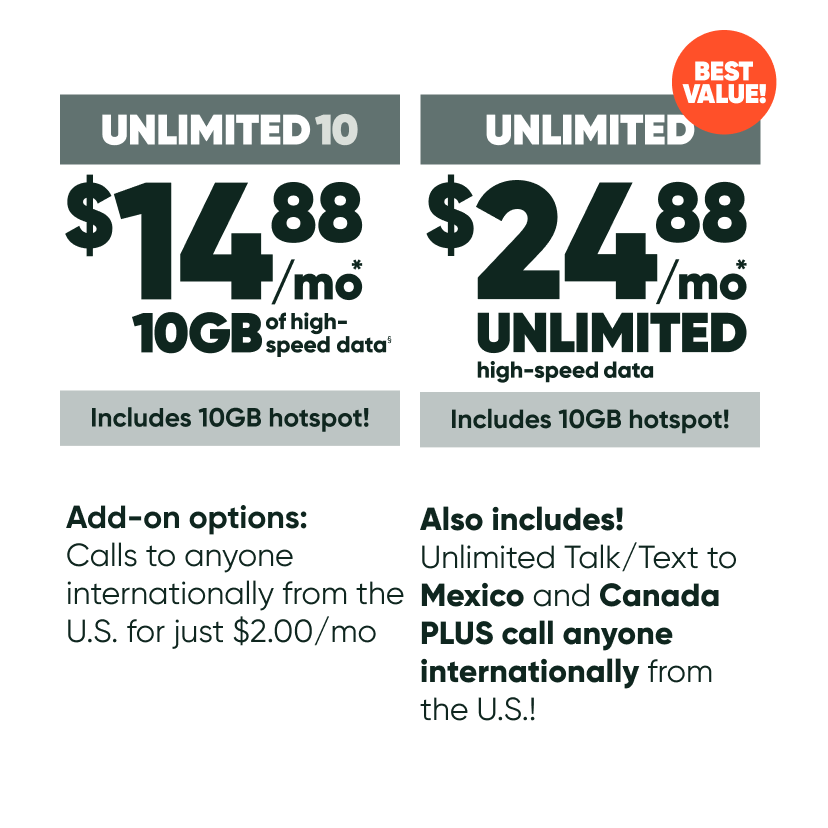
- Unlimited if you want it — if the peace of mind is worth it to you, we offer some of the best prepaid smartphone plans like Unlimited 10 with 10GB of high-speed data for $14.88/month or Unlimited 30 with 30GB of high-speed data for $24.88/month. No throttling surprises, no hidden fees.
All of this runs on one of the fastest 5G networks in America.
Start here
Pull up your current carrier’s app right now and check your data usage for the last three months. For most people, the number is lower than they expect, and almost certainly lower than whatever plan they’re paying for.
That gap between what you use and what you pay for? That’s money you could stop spending today.
Frequently Asked Questions
What’s the cheapest MobileX plan? Customized plans start as low as $3.88/month for 1GB of data.
Does MobileX offer unlimited plans? Yes. We offer Unlimited 10 with 10GB of high-speed data for $14.88/month and Unlimited 30 with 30GB of high-speed data for $24.88/month.
Does unused data roll over? Yes. On personalized access plans, any data you purchase but don’t use rolls over as a credit toward your next bill.
What network does MobileX use? MobileX runs one of the most reliable 5G networks in the country.
Not sure which cellular plans fit your needs? Download the MobileX app, let our AI figure it out in 10 days or less, and start paying only for what you actually use. Pick up a MobileX Activation Kit through our website, on Amazon or at one of 3,700 Walmart locations.




 Spanish
 English