Got questions? Start a live chat now!

Five things your carrier isn’t telling you about your plan.

You read the headline price. You confirmed the data was unlimited and came with whatever else it’s supposed to include. You signed up.

That is how most of us pick phone plans, and your carrier is counting on it. The real story isn’t on the sign-up screen: how much you’re overpaying, what quietly changes once you’re locked in, and how hard it is to leave. Here are five of them.

1. You don’t need unlimited data

Unlimited sounds like the safe choice, so it’s the one carriers push hardest. But most people use a small fraction of what they pay for. In fact, more than 70% of MobileX customers are on a personalized plan over unlimited. 

If unlimited gives you peace of mind, that is fine, and we price it competitively as one of the most affordable mobile plans around. But most people pay every month for a cushion they never touch.

2. Your price isn’t locked the way you think

Carriers give you a false sense of security with price guarantees on their cellular plans. Three years, five years, locked in. It sounds like certainty, until you read what’s actually guaranteed.

These guarantees usually cover your base plan and nothing else. Taxes and surcharges, the line items that quietly climb, are almost always exempt, and the guarantee runs on a clock. Once the term ends, you’re at the carrier’s mercy, and the price almost always climbs. Call in to renegotiate and there’s a small chance you’ll cushion the increase with a loyalty discount, maybe even hold your current price for another year or two if you’re lucky. But that means sitting on hold and bargaining for a rate that used to be automatic.

3. Your tier will quietly get demoted

This is the move you don’t see coming. You pick the best of their cell phone plans… or so you think. A year later, they quietly remove a few perks and features from your plan, launch a flashier tier above it, and move the best perks up there. Just like that, your plan is the middle or low option. Same money, lower standing.

It’s the gym you joined on the top membership, right before they rolled out a pricier “elite” tier and quietly moved the classes, the sauna, and the prime hours into it. You didn’t change a thing, but your membership is suddenly the middle option. The only way back to the best is to pay up, so you do, and a year later, there’s an even higher tier waiting. The upgrade treadmill never really stops.

4. Loyalty can cost you money

Look at almost any carrier’s best phone plans and you’ll spot three quiet words: for new customers. The promo pricing and the device deals go to whoever just walked in, not to the people who’ve paid faithfully for years. 

To get the new-customer price again, you could act like a new customer: cancel and come back, or sign up under a friend or family member. It buys you a year or two, until that promo expires and you’re doing the whole dance over, juggling accounts and names just to be charged a fair rate. Eventually, you run out of friends and family to borrow. Loyalty becomes the one thing that costs you.

5. Your phone is locked, and leaving is built to annoy you

Switching is supposed to be simple, but it runs on a chain of small steps, and any one of them can quietly break the whole thing. You need a port-out PIN you can usually only get by calling in or visiting a physical store. Your account number has to match exactly. Your device has to be fully paid off. And your phone has to actually be unlocked, which some carriers won’t do unless you ask, and sometimes don’t do even when you have. Miss one step, or get burned by a SIM lock your old carrier never cleared, and the port stalls. A ten-minute switch turns into a lost afternoon on hold.

None of that friction is an accident. If leaving is annoying enough, most people just stay, even when the best prepaid plans are one app away.

The bottom line

Trying to maximize your budget with inexpensive mobile phone plans shouldn’t be a slow-motion trap. You shouldn’t be paying for data you never touch, watching the plan you chose quietly turn into a lesser one, or getting charged more than a stranger for sticking around. The price should mean what it says, and leaving should be your call, not an obstacle course either.

Frequently Asked Questions

How will I know how much data I need? MobileX’s AI Forecaster looks at how you actually use your phone and recommends an amount. Take its suggestion or choose any amount you want. If you use more or less, the app will recommend the best phone plans for you.

Can I keep my number if I switch? Yes. As long as you have your port-out PIN and account number, your number comes with you. Switching to our best prepaid wireless plans doesn’t mean starting over.

What happens to data I don’t use? On a personalized plan, leftover data rolls into account credit toward your next bill. If you buy a gigabyte, it’s yours.

What kind of phones work with MobileX? MobileX is compatible with most unlocked smartphones. You can check device compatibility directly in the MobileX app.


Ready for a carrier that tells you everything up front? Build prepaid phone plans that keep up with your life on our website, or pick up a MobileX Activation Kit on Amazon or at one of 3,700 Walmart locations.


First job, first apartment, first phone bill — how to get that one right.

You’ve figured out rent. You’ve figured out groceries (sort of). And now you’re staring at your phone bill wondering why it’s eating such a big chunk of your paycheck.

Here’s the thing: most people in their first apartment are overpaying for their phone plans. Not because they’re careless. Because nobody ever walked them through what good cell phone plans actually look like. The big carriers spend a lot of money to keep it confusing. Let us walk you through the conversation you should’ve had before you signed up.

The big carrier trap

When you landed your first job, you probably didn’t shop around for cell phone plans. You went with whoever your family was on,  whoever had a store near you, or whoever showed up first in a search. That’s how most people end up on a plan that costs $70–$90/month for a single line.

That’s not a deal. That’s the default.

The same network access (same towers, same 5G coverage) is available through smaller carriers at a fraction of the cost. These are called MVNOs, and they run on the exact same infrastructure as the big names. The difference is they don’t have thousands of retail locations, Super Bowl ads, or free-phone-that-costs-you-more schemes to pay for. They get you by offering the “best phone plans” on the market. Funny how that works.

What you actually need vs. what you’re being sold

Before you pick a plan, be honest about how you use your phone:

Data: Stream a lot? Check your usage in your phone settings. Most people are surprised to find they use under 10GB/month at home because Wi-Fi handles the heavy lifting. Even at work you’re probably using the company Wi-Fi. Thanks, I’ll take it!  On the go, it’s usually your commute, lunch breaks, and the occasional trip. Unless you’re streaming HD video all day without Wi-Fi, you probably don’t need unlimited.

Hotspot: If you are a digital nomad working from coffee shops or traveling a lot, hotspot data matters. Otherwise, it’s something you’re paying for and never touching.

International: Traveling abroad is not a reason to pay $80/month. Most good prepaid phone plans include international options you can add when you actually need them. Which is not every month unless you are a spy, a flight attendant, or spiritually unable to find Wi-Fi.

The honest answer for most 20-somethings: a few gigs of data, reliable coverage, and a phone bill that doesn’t require a group chat intervention on your phone usage.

Build-your-own is the move

The smartest cell plans right now aren’t one-size-fits-all. They let you pay for what you actually use. MobileX lets you build your own plan from scratch: choose your data, choose your features, and adjust as your life changes. Starting your first job and commuting through the city? You might need more data. Working from home most of the week? Probably less. Revolutionary concept, apparently.

This is what inexpensive mobile phone plans should look like: no mystery bundle, no carrier math, no paying for 47 things you don’t use. Just you, your data, and a bill that knows its place.

The math no one shows you

Here’s what switching can actually look like:

Typical big carrier single line: $75–$85/month 

A well-matched plan on MobileX: As low as $15–$25/month for most everyday users

That’s $600–$800 a year back in your pocket. In your first year out on your own, that’s a plane ticket, three months of groceries, or the emergency fund you’ve been meaning to start.

Prepaid mobile plans often get dismissed as “the budget option,” but that framing is completely backward. You’re not getting less. You’re just not paying for things you don’t need.

What to look for when you switch

Not all cheap phone plans are created equal. Here’s what actually matters:

Network quality: Check which major network your carrier runs on. MobileX runs on one of the largest 5G networks in the country, so coverage isn’t a compromise you’re making.

No contracts: If a plan requires a 12- or 24-month commitment, that’s a red flag. The best wireless phone plans let you pay month-to-month without penalty.

Transparent pricing: Your bill should be what they told you it would be. Shocking standard to have to set, but here we are.

Easy setup: Activating a new SIM should take about 15 minutes, not a two-hour store visit. MobileX is app-based. You download it, pick your plan, and you’re on.

A note on “free” phones

If a carrier is offering you a “free” phone, that phone is about as free as guac at Chipotle. It’s baked into your monthly bill over 24–36 months, which means you can end up paying hundreds more over time than if you bought the phone outright.

You’re also basically handcuffed to that carrier until it’s paid off — which, shockingly, works out very well for them. If you already own your phone (which most people in their 20s do), you can bring it to most carriers and start saving immediately.

The bottom line

Your phone bill is one of the easiest monthly expenses to take back control of. Unlike rent, student loans, or the mysterious $19.99 subscription you keep forgetting to cancel, your mobile plan is flexible, competitive, and there are genuinely good mobile plans that don’t cost a fortune.

Getting your first apartment means staring down every line in your budget. Your cell phone plan is one of the few that can look back and say, “Fair enough, I’ll be cheaper.”

The free phone trap: what carriers don’t tell you.

Free phone. Two words that have sold more cellular phone plans than any other promise in wireless history.

You’ve seen the ads. Walk in with your old device, walk out with the latest flagship smartphone at no cost. It sounds like a no-brainer. But here’s what the fine print doesn’t say upfront: there is no such thing as a free phone. There’s just a phone you pay for in ways that are harder to see.

Here’s how it actually works.

The 36-month math

When a carrier offers you a “free” phone, what they’re really offering is a monthly device credit spread across 36 months — three full years. Instead of giving you the phone outright, they apply a portion of the device’s value to your bill each month, as long as you stay on a qualifying plan.

That qualifying plan is almost always their most expensive tier. So the “free” phones come with mandatory unlimited phone plans you may not need, at a price point that’s significantly higher than what you’d otherwise pay.

Run the numbers over 36 months and the phone is rarely free. It’s just paid for differently, in a way that’s harder to track and easier to forget.

What happens if you leave early

This is where it gets expensive. If you decide to switch carriers before your 36 months are up — because you found a better phone plan, because your service isn’t what you expected, because anything changed in three years, you lose the remaining device credits.

That means you’re on the hook for the full remaining balance of the phone. A flagship smartphone that was supposed to be “free” can suddenly cost you $400, $500, $600 or more the moment you decide to leave.

It’s one of the most effective retention tools in the industry. Not because the service is good enough to keep you, but because leaving costs too much.

The trade-in trap

Many free phone offers also require a trade-in. Your old device gets valued — usually below market rate — and that trade-in value becomes part of the credit calculation. So you hand over a phone that might be worth $300 on the open market, get credited $200 toward a new device, and lock yourself into a 36-month agreement in the process.

If you’d sold that phone yourself and put the money toward an unlocked device on a cheaper phone plan, you’d likely come out ahead. But that requires doing math that carriers are not motivated to help you do.

The plan requirement

Here’s the part that often gets missed entirely. Most free phone promotions require you to stay on a specific, higher-tier prepaid or postpaid plan for the full 36 months. Drop down to less expensive phone plans and you lose the credits. Switch plans and you may forfeit the remaining device value entirely.

You’re not just locked into a carrier. You’re locked into a price point. And that price point is almost always higher than what you’d pay if you’d bought the phone outright and chosen your cell plan independently.

The smarter way to think about it

Separating your device from your phone plan is one of the most underrated moves in wireless. When they’re bundled together, it’s nearly impossible to evaluate whether you’re getting a good deal on either one. When they’re separate, you can make a clear-eyed decision about each.

Buy the device you want, at the price that makes sense. Then choose one of the best cell phone plans for your actual usage. If your needs change, you can adjust your plan without losing anything. If you want to switch carriers, you can do that too — no penalties, no forfeited credits, no math to untangle.

It’s a simpler way to manage your wireless life. And in the long run, for most people, it’s a less expensive one.

Frequently Asked Questions

Is a free phone ever actually free? Rarely. Most free phone offers are device credits spread across 36 months or even longer, tied to a qualifying plan. Leave early and you forfeit the remaining credits and owe the balance on the device.

What should I look for before accepting a free phone offer? Check the required plan tier and its monthly cost, the length of the commitment, what happens to your credits if you switch plans or carriers, and what your trade-in device is actually worth on the open market before handing it over.

What does it mean to separate my device from my plan? It means buying your phone outright or through a third party, then choosing cellular plans independently. You’re not locked into any carrier or price point, and you can adjust either one at any time without penalty.

What kind of phones work with MobileX? MobileX is compatible with most unlocked smartphones. You can check device compatibility directly in the MobileX app.


Ready to take back control? Build the phone plan that fits your actual life on our website, or pick up a MobileX Activation Kit on Amazon or at one of 3,700 Walmart locations.

The fees hiding in your phone bill every month.

You signed up for a $60 phone plan. Your bill is $75. You’ve checked it three times and still can’t figure out where the extra $15 is going.

You’re not imagining it. And you’re not alone.

The gap between what carriers advertise and what you actually pay is one of the most consistent frustrations in wireless. Here’s exactly what those extra charges are, why they exist, and how to stop paying them by finding the best cell phone plans for your budget.

The fees that sound official but aren’t

Scan your phone bill and you’ll likely see charges with names like “Regulatory Recovery Fee” or “Administrative and Telco Recovery Charge.” They sound like government taxes. They are not.

These are fees carriers invented themselves. They can raise them whenever they want, with no government oversight and no cap. One major carrier recently raised its recovery fee to nearly $4.50 per voice line per month, and its own website confirms this is not a government tax. It’s a fee the carrier collects and keeps.

The administrative fee is even more vague. Carriers describe it as covering “general costs of operations,” an umbrella term that can mean almost anything. These fees have quietly increased across the industry in recent years, often with little notice and no explanation. Most people never catch it because it’s buried in the fine print.

This isn’t just frustrating. It’s been taken to court. Multiple class action lawsuits have been filed against the biggest names in wireless over fees customers say were deliberately disguised as government charges. One settlement alone cost $100 million. The fees are still there.

The activation fee

Switching to new cell phone plans or adding a line? Prepare for an activation fee on top of everything else. These one-time charges can run anywhere from $10 to $45 per line. Carriers justify it as the cost of setting up your service, even though the process is largely automated today.

It’s a charge for something that costs the carrier almost nothing to do. And it’s one of the first things you’ll notice is missing when you switch to prepaid phone plans that don’t believe in padding the bill.

The promo cliff

Many carriers hook you with introductory rates that don’t tell the whole story. You sign up for less expensive phone plans at $25 a month, only to find out in month four that the price has doubled. It’s designed to bank on your inertia. They’re betting you won’t notice, or won’t want the hassle of switching again.

And to even qualify for that advertised price on many cellular plans, carriers often require you to link your checking account or debit card to get the discount. It’s framed as a convenience. It’s actually a way to avoid credit card processing fees while keeping tighter control over your payments.

What a truly transparent phone bill looks like

At MobileX, we think you should know exactly what you’re paying for before you pay it. No recovery fees, no administrative charges, no activation fees. Just one platform fee of $1.98 a month, and the cost of your plan.

That’s it. One line item you can actually explain.

Our customized plans start at $3.88/month. One platform fee of $1.98 a month, plus applicable taxes – and that’s it. No recovery fees, no administrative charges, no activation fees, no promo rates that quietly double. Just one of the most affordable mobile plans on the market, priced exactly as advertised.

How to audit your current bill

Before your next billing cycle, take five minutes and do this:

  1. Pull up your current phone bill and add up every line item that isn’t your base plan cost or a government tax.
  2. Search each fee name online to find out if it’s a genuine government charge or a carrier-invented one.
  3. Add up what those fees cost you annually. For most people on traditional cellular phone plans, the number is surprising.

Once you see it, it’s hard to unsee. And once you know what a clean, transparent bill looks like, it’s hard to go back to paying for fees that were invented to pad someone else’s margins.

Frequently Asked Questions

What fees does MobileX charge? One platform fee of $1.98 a month. That’s it. No activation fees, no recovery fees, no administrative charges.

Are regulatory recovery fees real government taxes? No. Despite the official-sounding names, these are fees carriers create themselves. They are not government-mandated and carriers can raise them at any time.

Can I really switch to better prepaid phone plans without paying an activation fee? Yes. MobileX charges no activation fee. You can get started through the MobileX app, on Amazon, or at one of 3,700 Walmart locations.
How do I find out what I’m actually paying for on my current bill? Log into your carrier account and look for any line items beyond your base plan and government taxes. Anything else is a carrier-invented fee.


Tired of paying for fees you never agreed to? Build your own phone plans and pick up a MobileX Activation Kit through our website, on Amazon or at one of 3,700 Walmart locations.

The unlimited data myth.

Unlimited data gets a lot of attention. It’s on every carrier ad, every comparison site, every store window. And for some people, it genuinely makes sense. Heavy streamers, frequent travelers, people who use their phone as a hotspot, unlimited is probably the right call.

But here’s the thing: most people aren’t those people.

If you’re paying for unlimited and not sure why, this post is for you.

The $141 question

According to J.D. Power, the average American pays $141 a month for their cell phone plans. That’s nearly $1,700 a year. For a lot of people, a significant chunk of that is going toward data they never actually use.

The average mobile user consumes far less data than they realize. Streaming music on the commute, scrolling social media, checking maps, watching the occasional video. Normal phone life. And most of the time, people are on Wi-Fi without even thinking about it. At home, at work, at a coffee shop.

If that sounds like you, there’s a good chance you’re on the wrong phone plan.

What’s worth knowing about unlimited

Here’s what most carriers don’t tell you when they sell you unlimited, whether that’s prepaid phone plans or postpaid.

Most unlimited cell plans have a threshold, usually somewhere between 30GB and 100GB, where speeds get throttled. MobileX is no different; after your high-speed data threshold, speeds also get reduced. We just think you should know that upfront. On top of that, standard unlimited customers are typically subject to deprioritization, meaning when towers get congested, premium-tier users get priority access first.

None of this is a dealbreaker if unlimited is genuinely what you need. But if you’re using a small amount of data each month, you’re paying a premium for features that don’t apply to your life.

Finding the plan that actually fits

More than 70% of MobileX customers choose a personalized plan over unlimited and save significantly as a result. Not because unlimited is wrong, but because it wasn’t right for them.

MobileX gives you both options, and the tools to figure out which one makes sense:

  • True pay as you go — build your own customized prepaid phone plans starting at just $3.88/month, with any data, talk, and text combo you need. Add Gold Network priority access for the times you actually need a boost.
  • AI-powered savings — our AI Forecaster analyzes your usage in the background and recommends the most affordable phone plans based on how you actually use your phone. Not how the carrier wants you to use it.
  • Data that’s yours — any unused data on a personalized plan rolls over as account credit toward your next bill. You never lose what you paid for.
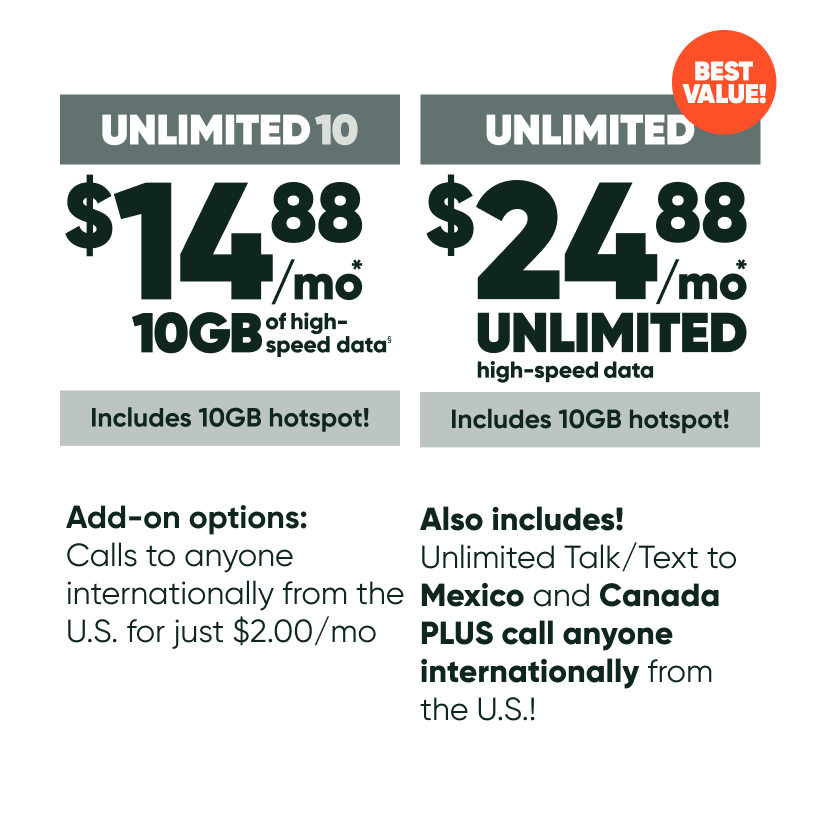
  • Unlimited if you want it — if the peace of mind is worth it to you, we offer some of the best prepaid smartphone plans like Unlimited 10 with 10GB of high-speed data for $14.88/month or Unlimited 30 with 30GB of high-speed data for $24.88/month. No throttling surprises, no hidden fees.

All of this runs on one of the fastest 5G networks in America. 

Start here

Pull up your current carrier’s app right now and check your data usage for the last three months. For most people, the number is lower than they expect, and almost certainly lower than whatever plan they’re paying for.

That gap between what you use and what you pay for? That’s money you could stop spending today.

Frequently Asked Questions

What’s the cheapest MobileX plan? Customized plans start as low as $3.88/month for 1GB of data.

Does MobileX offer unlimited plans? Yes. We offer Unlimited 10 with 10GB of high-speed data for $14.88/month and Unlimited 30 with 30GB of high-speed data for $24.88/month.

Does unused data roll over? Yes. On personalized access plans, any data you purchase but don’t use rolls over as a credit toward your next bill.

What network does MobileX use? MobileX runs one of the most reliable 5G networks in the country.


Not sure which cellular plans fit your needs? Download the MobileX app, let our AI figure it out in 10 days or less, and start paying only for what you actually use. Pick up a MobileX Activation Kit through our website, on Amazon or at one of 3,700 Walmart locations.

WHY MOBILEX?
BECAUSE... WE'RE ALL ABOUT YOU..


Hi. We’re MobileX. And we’re different. We think it’s unbelievable the way the Telco industry lumps everyone into one-size-fits-all plans…forcing you to pay too much for data you probably won’t use. MobileX is a team of industry experts with a long history of fighting for regular joes, who’ve come together to create a new kind of carrier that’s breaking all the rules—and giving control back to you!


Unlimited Worldwide Calls to
100+ Countries

(M) = Unlimited to Mobile (L) = Unlimited to Landline (ML) = Unlimited to Mobile & Landline


MOST POPULAR COUNTRIES!

India (ML)

China (ML)

Guatemala (L)

El Salvador (L)

Dominican Republic (L)

Israel (ML)

South Korea (ML)

Philippines (M)

Vietnam (ML)

Pakistan (ML)

Bangladesh (ML)

Mexico (ML)

Canada (L)

North America & Caribbean

Aruba (L)

Bermuda (ML)

Cayman Islands (L)

American Samoa (ML)

Guam (ML)

Mariana Islands (ML)

Martinique (L)

Puerto Rico (ML)

US Virgin Islands (ML)

St. Maarten (L)

Trinidad and Tobago (L)

South America & Central America

Argentina (ML)

Brazil (ML)

Chile (ML)

Colombia (ML)

Costa Rica (ML)

French Guiana (L)

Panama (L)

Paraguay (ML)

Peru (ML)

Uruguay (L)

Venezuela (ML)

Europe

Andorra (L)

Austria (L)

Belgium (L)

Bulgaria (L)

Croatia (L)

Cyprus (L)

Czech Republic (ML)

Denmark (M)

Estonia (L)

Faroe Islands (ML)

Finland (M)

France (ML)

Germany (ML)

Gibraltar (L)

Greece (ML)

Greenland (L)

Guadeloupe (L)

Hungary (ML)

Iceland (ML)

Ireland (ML)

Italy (ML)

Kazakhstan (L)

Liechtenstein (ML)

Luxembourg (L)

Malta (L)

Monaco (L)

Netherlands (L)

Norway (ML)

Poland (ML)

Portugal (L)

Reunion Island (L)

Romania (ML)

Russia (L)

Slovakia (L)

Spain (ML)

Sweden (ML)

Switzerland (L)

Ukraine (L)

United Kingdom (ML)

Middle East & Africa

Algeria (L)

Cameroon (L)

Egypt (M)

Kenya (M)

Kuwait (ML)

Mauritius (L)

Morocco (L)

Namibia (ML)

Nigeria (M)

Oman (L)

Saudi Arabia (L)

South Africa (ML)

Turkey (L)

Asia & Pacific

Australia (ML)

Bhutan (ML)

Brunei (M)

Cambodia (ML)

Hong Kong (ML)

Indonesia (ML)

Japan (ML)

Laos (ML)

Macao (L)

Malaysia (ML)

Mongolia (ML)

Myanmar (L)

New Zealand (ML)

Singapore (ML)

Taiwan (L)

Thailand (ML)

Download our complete ILD destinations list HERE

So...how does the
mobileX data match
actually work?

We know what you’re thinking...this can’t be right, right?!? It is.


Any data you purchase when on Personalized Access we will match. That’s double your data at no extra cost. Crazy right?


Here’s how it works:


You live, we learn. When you select Personalized Access, our app will suggest a custom data amount to best suit your usage. You can choose the amount our app recommends—or any amount you like—build your plan, your way.


It doesn’t matter what amount you end up choosing—we’ll match it, gigabyte for gigabyte, automatically doubling your data allowance upon purchase.


And, if at any time you want to top up your account with extra data, we’ll match that too! As long as you’re on Personalized Access we’ll double the data you buy.


Find out more in our FAQs.

Find your carrier below, and contact them today to unlock your phone.

1. Make sure your phone is paidoff

2. Ask your current provider for a port-out PIN if you're going to transfer your phone number

3. Request they unlock your phone (some carriers don't automatically do it unless you've requested they unlock it)


Verizon Wireless

1-800-922-0204


AT&T

1-800-331-0500


T-Mobile

1-800-937-8997


Sprint (now merged with T-Mobile)

1-888-211-4727


Mint Mobile

1 (800) 683-7392


Xfinity Mobile

1-888-936-4968


US Cellular

1-888-944-9400


Cricket Wireless

1-800-274-2538


Metro by T-Mobile

1-888-863-8768


Boost Mobile

1-833-50-BOOST (1-833-502-6678)


Google Fi

1-844-492-7737


Spectrum

1-833-224-6603


NEED HELP? HAVE QUESTIONS?
JUST WANT TO TELL US HOW MUCH YOU LOVE MOBILEX?

XPERTCARE

Chat with an Xpert 7-days a week from 8am-12am ET

Live Chat


Frequently Asked Questions


TESTIMONIALS

Current MobileX user? We'd love to hear from you! Take our survey and provide your feedback. Visit mymobilex.com/survey.


CAREERS

Send us your resume to careers@mymobilex.com and we’ll let you know when we’re hiring.


es_MXSpanish