
You’ve figured out rent. You’ve figured out groceries (sort of). And now you’re staring at your phone bill wondering why it’s eating such a big chunk of your paycheck.
Here’s the thing: most people in their first apartment are overpaying for their phone plans. Not because they’re careless. Because nobody ever walked them through what good cell phone plans actually look like. The big carriers spend a lot of money to keep it confusing. Let us walk you through the conversation you should’ve had before you signed up.
The big carrier trap
When you landed your first job, you probably didn’t shop around for cell phone plans. You went with whoever your family was on, whoever had a store near you, or whoever showed up first in a search. That’s how most people end up on a plan that costs $70–$90/month for a single line.
That’s not a deal. That’s the default.
The same network access (same towers, same 5G coverage) is available through smaller carriers at a fraction of the cost. These are called MVNOs, and they run on the exact same infrastructure as the big names. The difference is they don’t have thousands of retail locations, Super Bowl ads, or free-phone-that-costs-you-more schemes to pay for. They get you by offering the “best phone plans” on the market. Funny how that works.
What you actually need vs. what you’re being sold
Before you pick a plan, be honest about how you use your phone:
Data: Stream a lot? Check your usage in your phone settings. Most people are surprised to find they use under 10GB/month at home because Wi-Fi handles the heavy lifting. Even at work you’re probably using the company Wi-Fi. Thanks, I’ll take it! On the go, it’s usually your commute, lunch breaks, and the occasional trip. Unless you’re streaming HD video all day without Wi-Fi, you probably don’t need unlimited.
Hotspot: If you are a digital nomad working from coffee shops or traveling a lot, hotspot data matters. Otherwise, it’s something you’re paying for and never touching.
International: Traveling abroad is not a reason to pay $80/month. Most good prepaid phone plans include international options you can add when you actually need them. Which is not every month unless you are a spy, a flight attendant, or spiritually unable to find Wi-Fi.
The honest answer for most 20-somethings: a few gigs of data, reliable coverage, and a phone bill that doesn’t require a group chat intervention on your phone usage.
Build-your-own is the move
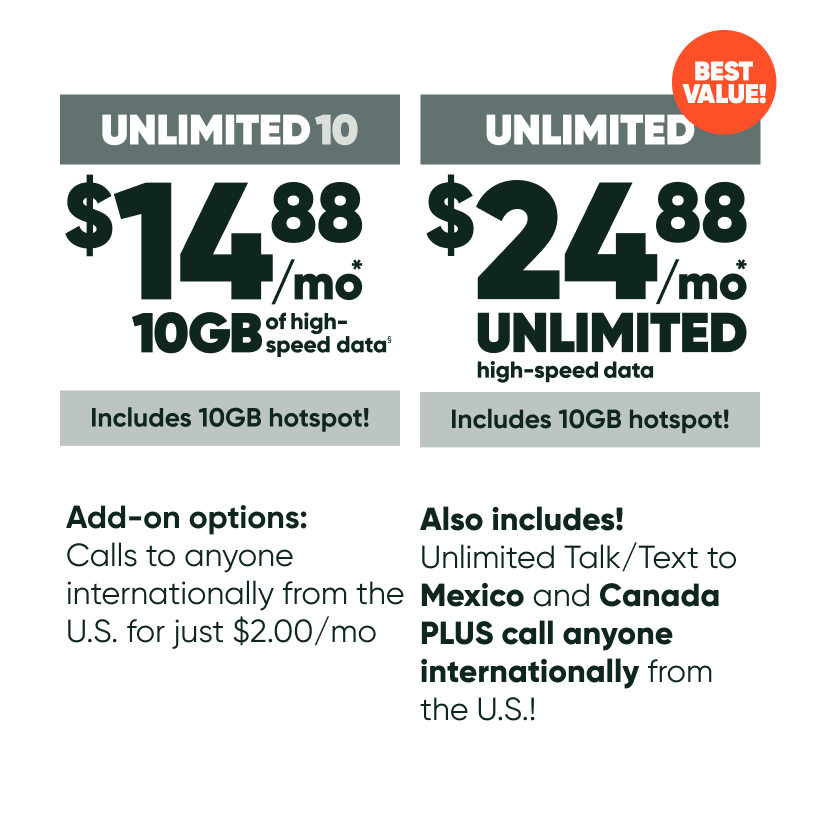
The smartest cell plans right now aren’t one-size-fits-all. They let you pay for what you actually use. MobileX lets you build your own plan from scratch: choose your data, choose your features, and adjust as your life changes. Starting your first job and commuting through the city? You might need more data. Working from home most of the week? Probably less. Revolutionary concept, apparently.
This is what inexpensive mobile phone plans should look like: no mystery bundle, no carrier math, no paying for 47 things you don’t use. Just you, your data, and a bill that knows its place.
The math no one shows you
Here’s what switching can actually look like:
Typical big carrier single line: $75–$85/month
A well-matched plan on MobileX: As low as $15–$25/month for most everyday users
That’s $600–$800 a year back in your pocket. In your first year out on your own, that’s a plane ticket, three months of groceries, or the emergency fund you’ve been meaning to start.
Prepaid mobile plans often get dismissed as “the budget option,” but that framing is completely backward. You’re not getting less. You’re just not paying for things you don’t need.
What to look for when you switch
Not all cheap phone plans are created equal. Here’s what actually matters:
Network quality: Check which major network your carrier runs on. MobileX runs on one of the largest 5G networks in the country, so coverage isn’t a compromise you’re making.
No contracts: If a plan requires a 12- or 24-month commitment, that’s a red flag. The best wireless phone plans let you pay month-to-month without penalty.
Transparent pricing: Your bill should be what they told you it would be. Shocking standard to have to set, but here we are.
Easy setup: Activating a new SIM should take about 15 minutes, not a two-hour store visit. MobileX is app-based. You download it, pick your plan, and you’re on.
A note on “free” phones
If a carrier is offering you a “free” phone, that phone is about as free as guac at Chipotle. It’s baked into your monthly bill over 24–36 months, which means you can end up paying hundreds more over time than if you bought the phone outright.
You’re also basically handcuffed to that carrier until it’s paid off — which, shockingly, works out very well for them. If you already own your phone (which most people in their 20s do), you can bring it to most carriers and start saving immediately.
The bottom line
Your phone bill is one of the easiest monthly expenses to take back control of. Unlike rent, student loans, or the mysterious $19.99 subscription you keep forgetting to cancel, your mobile plan is flexible, competitive, and there are genuinely good mobile plans that don’t cost a fortune.
Getting your first apartment means staring down every line in your budget. Your cell phone plan is one of the few that can look back and say, “Fair enough, I’ll be cheaper.”




 English
  Spanish